
From the Guggenheim you tour top-down to a Copenhagen tower a tsar rode up on horseback.
Most twists in architecture are a flourish — a bit of drama bolted onto an ordinary box to get it photographed. The buildings below are the opposite. Take the coil away and there is no building left: the spiral is the structure, the route, the reason the thing exists at all. Some you can climb, one you can only stare up at, and one closed itself off for the saddest of reasons and came back wrapped in steel mesh. Here are thirteen places where somebody decided a straight line simply wouldn’t do.
Solomon R. Guggenheim Museum, New York
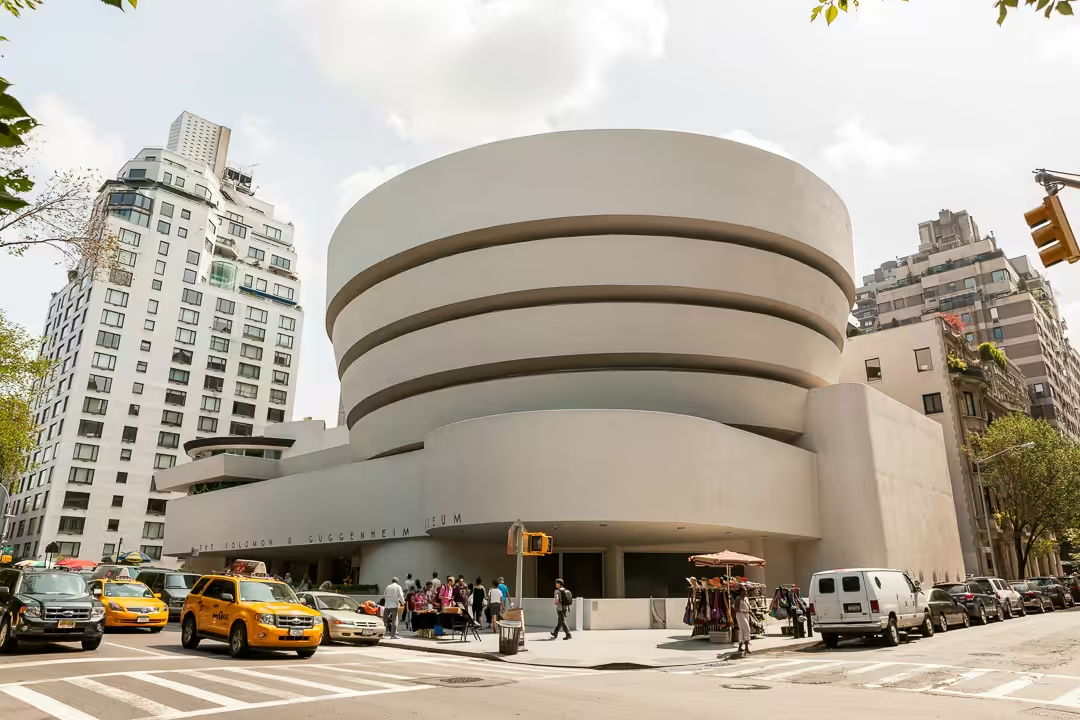
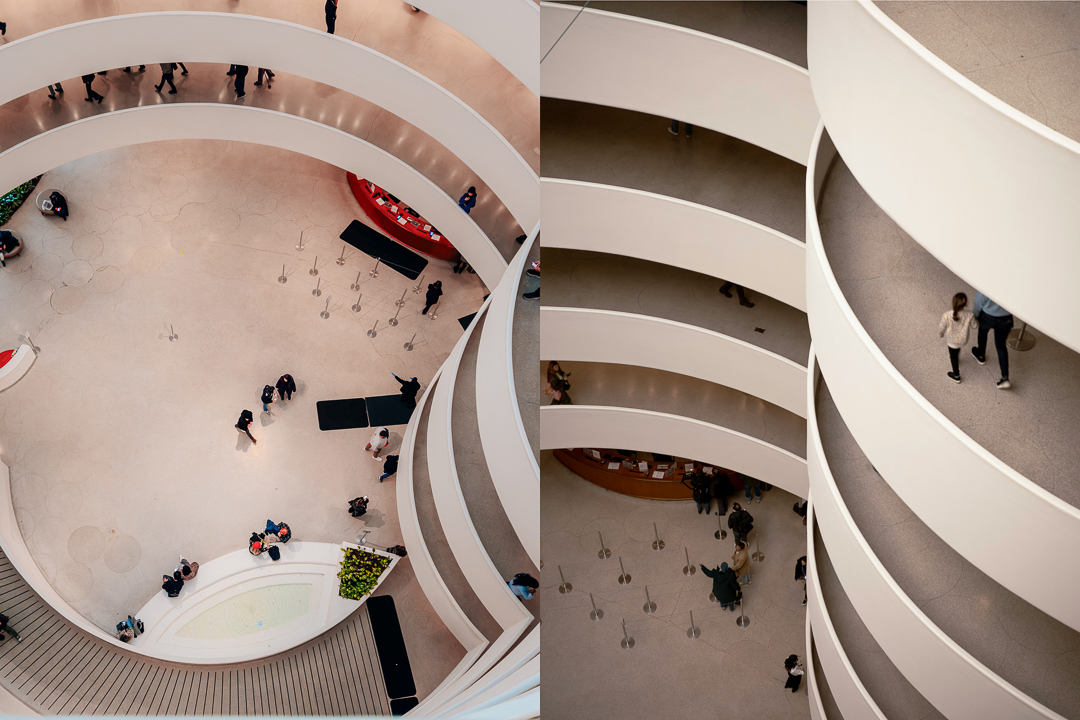
Frank Lloyd Wright spent fifteen years arguing the museum should be turned inside out, and won: you ride the elevator to the top and walk down, following a single unbroken ramp — roughly a quarter of a mile of it — as it uncoils around a skylit drum. He called the shape an inverted ziggurat, and he built it as a rebuke to the neutral white box decades before the white box became the rule. It opened in October 1959, six months after he died, so he never saw a visitor take the walk he’d choreographed. UNESCO added it to the World Heritage list in 2019, one of only two sites in New York City. Book timed entry and check whether an exhibition has closed a stretch of the ramp before you go — occasionally one does.

Turning Torso, Malmö
Before it was a fifty-four-storey tower it was a small white marble sculpture on Santiago Calatrava’s desk: a human spine caught mid-twist, vertebra on vertebra. The Swedish developer saw it and asked him to build it at the scale of a skyscraper. So the Torso is exactly that — nine five-storey cubes rotating a full ninety degrees from pavement to roof, about 1.6 degrees a floor, a body wringing itself out over the Öresund. It was the tallest building in the Nordics until Gothenburg’s Karlatornet pipped it in 2022, and it is widely credited as the first true twisting skyscraper, the one that set off the whole rotating-tower craze that follows in this list. One catch: people live and work in it, so there’s no walk-up lobby. A 53rd-floor viewing platform opens by advance booking only. The rest of us photograph the spine from the waterfront, low sun raking the pentagon steps.


The Vatican’s double-helix staircase, Rome
Here is the thing almost nobody photographing it knows: the famous spiral at the exit of the Vatican Museums — the one that fills every Rome carousel, twin bronze balustrades winding down under a glass dome — is a copy. Giuseppe Momo built it in 1932. Donato Bramante’s actual original, a helical ramp from 1505 designed so servants could ride mules up to the Belvedere without dismounting, sits elsewhere in the complex and is closed to the general route; you reach it only on a special-itinerary tour. Momo’s version is a genuine double helix, two intertwined spirals threaded so that people going up and people coming down never cross paths. Nearly every one of the museum’s visitors ends the day on it, which means you will share the shot — timed tickets sell out weeks ahead.


Shanghai Tower
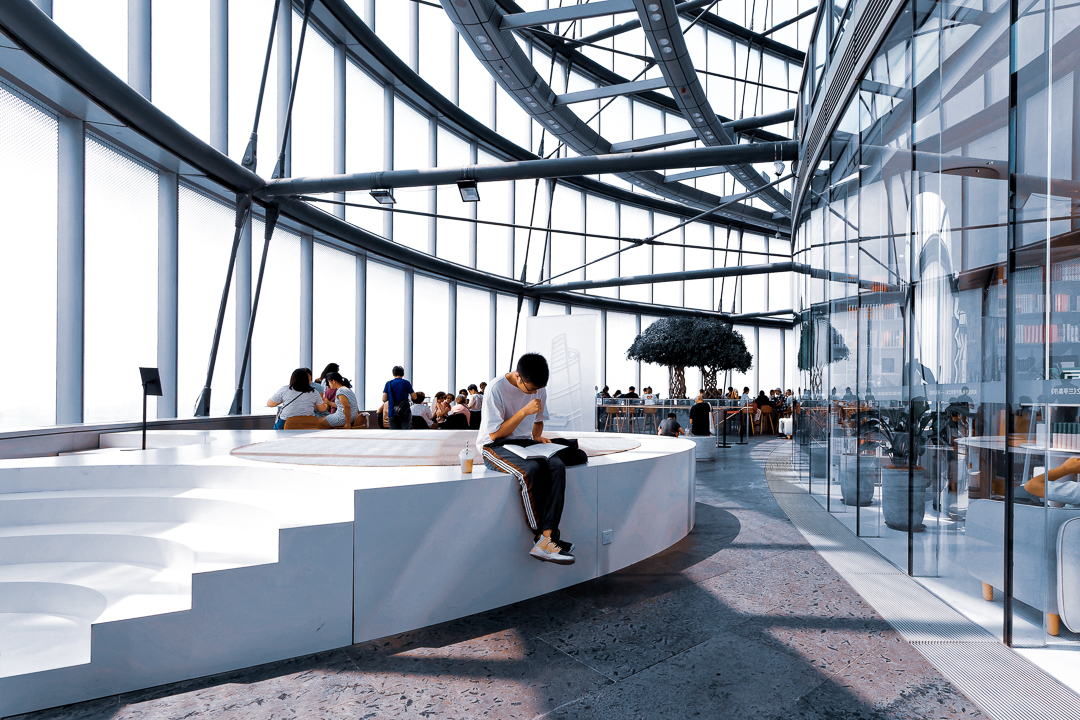
The twist here isn’t sculpture, it’s arithmetic. Gensler’s 632-metre giant rotates its glass skin a hundred and twenty degrees as it climbs, and the angle was settled in a wind tunnel: the rounded, tapering, turning form sheds roughly a quarter of the wind load a boxy tower of the same height would fight, which saved something like fifty-eight million dollars in structural steel. The rotation also opens nine stacked sky-garden atria in the gap between its two glass walls. It holds the Guinness record for the world’s tallest twisting building, and it’s the tallest in China — among the three tallest anywhere. Ride one of the planet’s fastest elevators, 18 metres a second, to an observation deck that ranks among the highest on earth, roughly fifty-five seconds from the ground.


Rundetaarn, Copenhagen
No stairs. That’s the whole trick of Christian IV’s Round Tower, finished in 1642: a cobbled spiral ramp winds seven and a half times around a hollow brick core, 209 metres of gentle gradient, because the king wanted to reach his observatory at the top without leaving the saddle. It worked well enough that Peter the Great reputedly rode a horse up in 1716, his tsarina following behind in a carriage. Hans Christian Andersen borrowed the hollow core for The Tinderbox — the dog with eyes “as big as the Round Tower.” It’s still one of the oldest working observatories in Europe, and the cheapest good rooftop view in the city; the ramp curving up around that dim central shaft is the picture. Practical visitor details here.


The Vessel, New York
For a while this was the most Instagrammed object in Hudson Yards: Thomas Heatherwick’s copper-clad honeycomb of staircases, 154 interconnecting flights and around 2,500 steps folded into a shape with no top-floor gallery, no exhibition, nothing to do but climb — a jungle gym built for a giant, drawing loosely on Indian stepwells. Then it became something else. After four people died by suicide from its heights, it closed in 2021, and the debate about whether a building can be responsible for that played out in public. It reopened in October 2024 encased for most of its sixteen storeys in floor-to-ceiling steel mesh, with the top level sealed off for good. Go in with that knowledge; a coppery lattice you can no longer climb to the top of is a stranger, sadder thing than the postcard promised. Reserve a timed slot; the netting shows on close frames, so shoot it wide.


Mercedes-Benz Museum, Stuttgart
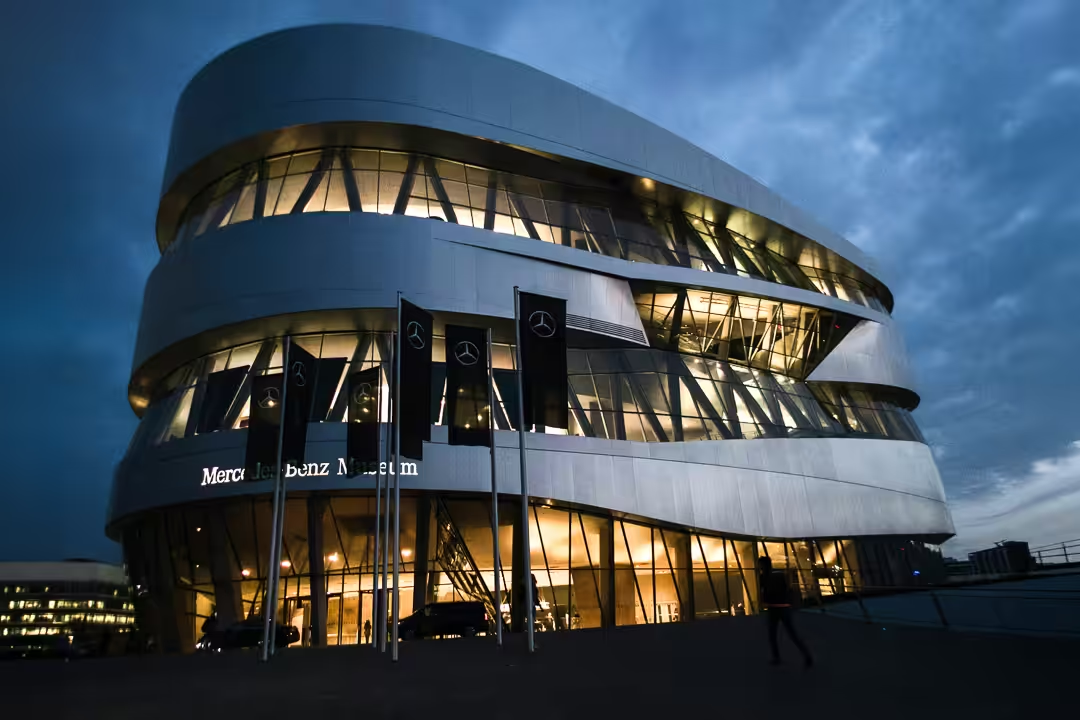
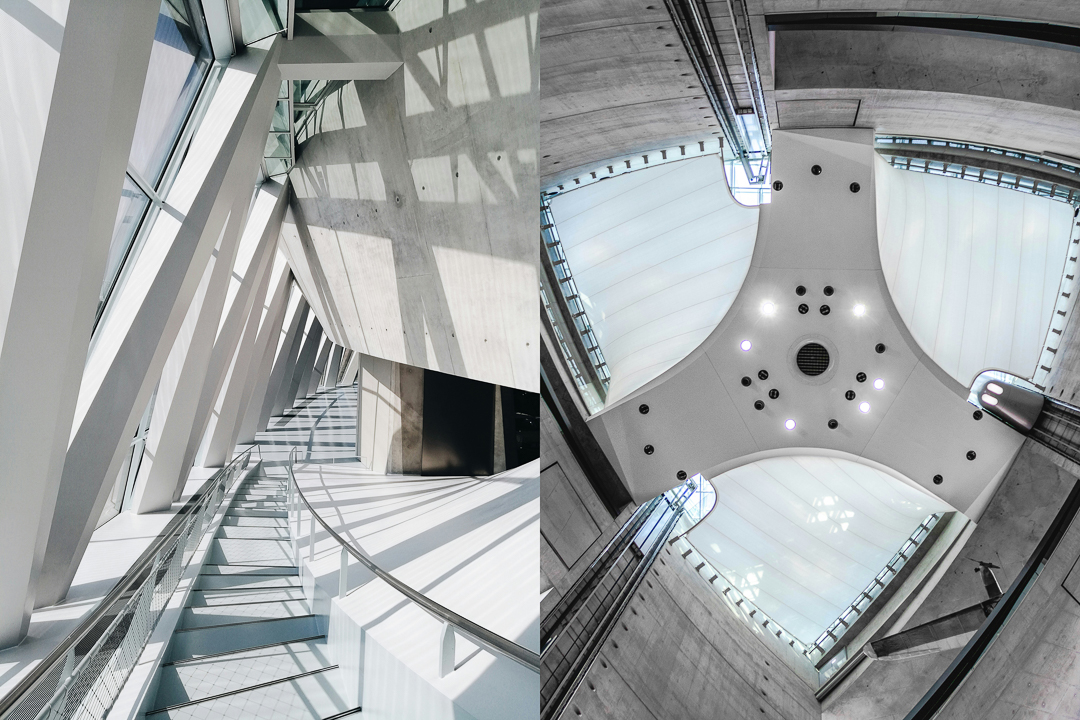
UNStudio’s building is a private joke told in reinforced concrete. In plan it’s a cloverleaf — three overlapping circles with the middle punched out — which leaves a triangular atrium that the architects will happily tell you nods to a Wankel rotary engine. Inside, a double helix does the real work: two ramps spiral down around that void, one telling the “Collection” story and one the company “Myth,” crossing only where Ben van Berkel lets them, exactly like the DNA strands they’re modelled on. The geometry earns its keep — the twist folds 16,500 square metres of exhibition onto a footprint of just 4,800. Take the lift to the top and let the spiral carry you down through 130 years of cars. Tickets here.

Absolute World Towers, Mississauga
Locals took one look at the curves and named them the Marilyn Monroe Towers, and the nickname stuck harder than “Absolute World” ever will. The taller of Ma Yansong’s two condominiums — a competition win that put his young studio, MAD, on the map — rotates a total of 209 degrees from base to crown, the angle shifting as it rises so that no two floors line up and every balcony wraps the full way around. It’s the rare tower with not a single straight edge, an hourglass in a city of glass rectangles. You can’t go in; they’re apartments. But catch the pair together in late sun, when the light models every stacked ripple of balcony, and you understand why a suburb west of Toronto keeps turning up in architecture books.


Loretto Chapel staircase, Santa Fe
The story the Sisters of Loretto told is this: their new chapel had a choir loft and no way up to it, so they prayed a novena to St. Joseph, patron of carpenters. On the ninth day a stranger arrived with a donkey and a toolbox, built a staircase that shouldn’t stand, and left without payment or a name. And the stair really is a small miracle of nerve — two complete 360-degree turns, thirty-three steps, no central pole to carry the load, held together (the story goes) with wooden pegs rather than nails. The likelier carpenter is a Frenchman named François-Jean Rochas: an 1895 Santa Fe obituary credits him with “the handsome staircase in the Loretto chapel,” and an 1881 convent ledger logs a payment for his wood. Believe whichever version you like. The chapel is a museum now and the stair is roped off — you look, you don’t climb. Visit details.


The Twist, Kistefos
Bjarke Ingels needed to get people across the Randselva river to the far half of a Norwegian sculpture park, and the south bank sat lower than the north. His answer was to torque the bridge: a 1,000-square-metre gallery that spans sixty metres of water and rotates ninety degrees along the way, so the floor at one end becomes the ceiling at the other. The twist is faked beautifully — straight aluminium slats fanned like a deck of cards, each nudged a fraction off its neighbour until a rigid beam reads as a warped ribbon. It’s gallery, bridge and sculpture in one object, the last link in a walking loop past fifty-odd works by Kusama, Kapoor and Eliasson. It runs on a season: the museum opens May to October, and the white volume crossing the water in autumn colour is the shot worth timing a trip around.


Cayan Tower, Dubai
Watch it long enough and Cayan Tower does something no photograph quite conveys: it turns to follow the view. SOM stacked seventy-five identical floor plates around a fixed core and rotated each one about a degree and a fifth, so the whole 306-metre slab completes a clean ninety-degree helix — and the point of the corkscrew is orientation. The lower apartments look out over the Dubai Marina promenade; the upper ones have swung around to face the Arabian Gulf, the building rewriting its own outlook as it climbs, while the twist keeps the worst of the desert sun off the glass. When it topped out in 2013 it was the tallest ninety-degree-twist tower going, until Shanghai out-turned it two years later. It’s residential, so there’s no going up — this is a look-from-the-promenade building, best at blue hour with the yacht basin throwing its light back up the spine.


Helix Bridge, Singapore
The shortest entry here, for the smallest structure — and the only one you’re meant to walk through rather than up. Cox Architecture wrapped a 280-metre footbridge over Marina Bay in two opposing spirals of stainless steel, a literal model of DNA: the strands are the backbone, and set into them are the paired bases, little lit letters reading c-g and a-t, glowing red and green after dark. It’s the longest pedestrian bridge in Singapore, it’s free, and it’s open around the clock. Cross it at night with Marina Bay Sands framed through the lattice.


Livraria Lello, Porto
Porto’s most beautiful bookshop turns 120 in 2026, and its crimson staircase — forking, curling, rejoining under a broad stained-glass skylight — is the reason people queue down the street. The carved wood, though, is a trick. Francisco Xavier Esteves built the stair in 1906 from reinforced concrete, some of the first in Portugal, then had the whole flowing sculpture skinned in plaster painted to imitate timber, grain and all: a trompe-l’œil that has fooled a century of visitors. (You may have heard it inspired a young J.K. Rowling; she has flatly denied it, saying she never so much as set foot inside.) Entry runs on a timed ticket-voucher from ten euros, and here’s the good part — spend it on a book inside and the fee comes right off the price. Come for the very first slot of the morning or not at all; by ten the red stair belongs to everyone.


Thirteen coils, corkscrews and helixes, and not a single straight staircase among them. Save the ones you’d cross an ocean to climb — then tell us which coil we left out.